Wednesday, April 24, 2024

Clayton in Photos Yesterday and Today

Entering Clayton from the south


Old Bird house, the first building of Clayton (that is now long gone) (Lenawee Museum photo)


Clayton Bible Church

Houses S. Church St (Hudson Museum postcard circa 1910)

Downtown Clayton circa late 1980's


Clayton railroad station, train coming from the west (Hudson Museum postcard circa 1910)


Clipping from Adrian Daily Telegram, circa early 1950's (Thank you to Teresa Hamann) Wilbur Cooke, President of the Clayton Exchange Bank, serving customer James Binns


Clayton School built in 1909, before the addition of the gymnasium (Hudson Museum postcard)


Looking east from the fire house tower, circa 1910 (David V. Tinder Collection of Michigan Photography, Wm. L. Clements Library, University of Michigan)

Unknown children on West Street, circa 1920 (Thank you to Paul Burcroff, from an old album of the Lord family now at Hudson Museum)


Tuesday, April 23, 2024

A Place They Call South Dover

1902 Graduates of Clayton High School (10th grade graduation), l. to r. Katharine Hynes 16, Mildred Jones 16, Lora Grattan 16 (author of "A Place They Call South Dover"), Claude Hawkins 16,  Edna Grattan 17, Lena Hale 18, Lura Gunzenhauser 18, and G. W. Wisman, Prof. (Hudson Museum Photo, special thank you to collector Teresa Hamann for the photo, captioning and the poem!)


Poem written for the 1958 South Dover Girls’ Reunion 

At May Foote Beal’s at Grass Lake, Mich.

By Lora Grattan


A few days ago I sat dreaming

And lived my young days over

My mind naturally wandered back

To a place they call South Dover


It wasn’t a village or a hamlet

Not a gas station nor a store

Just a small community

With an ever open door


The people were so friendly

So kind to one another

They treated everybody

As a sister or a brother


There were Hamlins, Whitakers and Benfields

Haleys, Gardners, Rhoades, Bovees

Warrens, Phillips, Walworths, Hyatts,

Grattans Delines and Footes if you please


In the midst of this fair country

Was a school house neat but small

And on the other corner

A church with steeple tall.

And nearly everyone around

Attended that church or school

Where’er they went, whatever they did

They lived the golden rule.


A few who were only children then

Have reunions once a year.

And even tho’ were getting gray

We give a hearty cheer.


To all who are left

Wherever they roam

And a silent prayer

To those gone home.


At this reunion, we have lots of fun

At games and reminiscing

And tell tales, about each other

Especially those who are missing.


Anna is most always there

With poems of her making

Selina usually gets there

Even if the speed she’s breaking


And Muriel, bless her little heart

The baby of the three

Always tries to make it

For she likes our company.


From Hudson comes our Zoa

Julia, Theresa and Mac

Ona comes from Bryan

Because she likes to get back


They may call us “the bloomer girls” if they like

But we have a lot of fun

And hope to keep on doing it

Until our days are done


Today we have Flossie with us

We’re really glad she’s here

There’s also Suzanne and Myrtle

And we hope they’ll all come

Next year.


1893 Lenawee Atlas, Dover Twp. showing
school, Church, Grange Hall and Cemetery (from S to N)


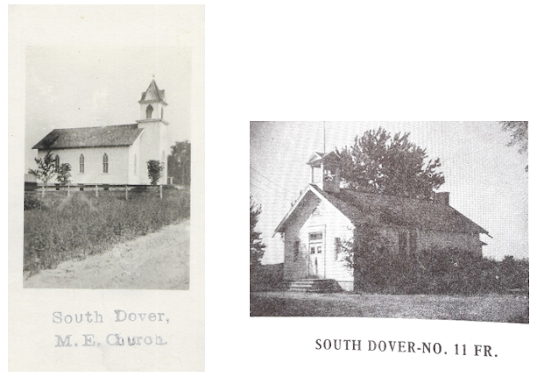
South Dover Church postal card from Hudson Museum, South Dover School from "The Little Red School," by the Foundation of Lenawee Education, 1976.

South Dover is one of many rural neighborhoods in our county.  These places were definitely more neighborly back 100 years ago when everyone attended either the local church or school!  Now schools are centralized and everyone travels in automobiles as far as they please.

Clubs were also very important and Grange was one of them.  At this date of 2024 there is only one county Grange left and that is North Adrian.  But once South Dover Grange was one of several dozen scattered throughout the county.  If anyone has a photo of the Grange building that was on Wheeler near Tomer, please leave a comment that can be replied to so we may arrange to share it!  I am posting a copy of my Grandpa's Grange membership card with the name of their Master DeWayne A. Clark and Esta Merritt, Secretary.  Clark's lived in the old Haley house on West Haley Road, the portion that is now closed by Lake Hudson.  Many of us attended school with the Clark children and his mother Mazie was our door-to-door Avon lady. The Granges met regularly and the history of meetings can be found in the personals columns in the Adrian Daily Telegram archives at Adrian District Library.


There are still some beautiful old places at the South Dover area.

Here is a more modern, circa 1930 photo of South Dover school students also courtesy of Hudson Museum, donated by collector Teresa Hamann.  You may recognize quite a few names and faces, as I did.  The Teacher's name is Miss Hughes.


You may also want to view the other Blogger site, Back to Old Medina's post "The Old Warren Day Place at South Dover" https://backtooldmedina.blogspot.com/2020/11/warren-day-farm-at-south-dover.html   (copy and paste link or see sidebar)  Also Find-a-Grave South Dover Cemetery also linked in sidebar for Back to old Medina.


Wednesday, April 17, 2024

Clayton Township Proposal of 1885


Back in 1885 the Clayton Village fathers and some Clayton area farmers decided they wanted to be in charge of taxation and other decisions free from the leaders of Hudson Township.  They proposed taking two tiers of sections from Hudson Township and one tier of sections from Dover Township to form their new Clayton Township.  Here is a representation of the area from a colorful 1864 county wall map.

In early 1885 this article was published in The Adrian Daily Times and Expositor, January 12:

"Clayton" Township.  During the last two meetings of the board of supervisors, a petition, praying for the organization of a new township to be called "Clayton," has been in consideration.  The petition asked that  twelve sections from the township of Hudson and six sections from the township of Dover, be incorporated in the new township.  The supervisors, after some discussion, decided to defer action in the premises until the people of the district in question could hold an election and decide for themselves.  The election was accordingly held last Saturday, resulting in favor of the new township by a majority of 129; the total vote was 251.  The opposition to the new project came mostly from the outskirts of the new town.  The election, which was held in Clayton, caused the most intense excitement, and the little town was overflowing with people all day.  

Those in favor of the new town are jubilant, and hope that the matter is settled for good.

________________________________


Clinton Township was set off from Tecumseh in 1869, leaving it and Tecumseh Township both in the exact same shapes and sizes of 18 one-mile sections.  So it's not like it had never been done!

What the Clayton men didn't anticipate was the ruthless nature of one Levi R. Pierson, Attorney for Hudson Township.  For a hint to his personality we can just look to his large tombstone with the stack of (presumably law) books on top, sitting alongside the fence on Cadmus Road in Hudson.  The wording on it, front and back have been obliterated by his relatives after his death!  Apparently a big embarrassment to them!  

 Also, it would have been very helpful for them to have a non-Hudson lawyer in their corner, no matter how nice Mr. Lane may have seemed. They went in expecting to state their case and were put off a whole day for whatever reason.  It was great that Mr. Sickly invited the Clayton men to meet at the Lawrence House (later called the Lenawee Hotel) where they would be heard at length.  (This was the year that the 1885 Court House was built and not occupied until around Dec. of that year.) The Clayton men accepted the invitation--and note that Mr. Sickly did vote in their favor the next day.   We are not given any details of the referenced 300 signature petition against the proposal, exactly where the signers resided (inside the proposed new township or outside of it), when it was taken, etc.

Below are 3 newspaper accounts here.  The sentence about to explain the reasoning of Messrs. Dewey, Finger and Moore explaining their votes:  It ends just like this with no explanation whatsoever!


March 25, 1885   The Adrian Daily Times and Expositor

 Item under heading “The Board of Supervisors”

The board met at nine o’clock this morning, with apparently good prospects for a lively session.  When the roll call and reading of the journal were through with, a number of small accounts were allowed. 

Mr. Swaney showed a petition signed by 300 or more people of Hudson township, remonstrating against the creation of the new township of Clayton.  The remonstrance was referred to the special committee on the proposed new township.

Mr. Sickly, chairman of that committee, said the committee would be ready to report to-morrow morning.

There had been an impression that the committee would report this morning, and, accordingly, Messrs. L. M. Judson, Aaron Abbott, Chas Peck, J. L. Perkins, T. Benfield, Chas. Haskins, W. B. Thompson, Ed. A. Baker, Silas A. Lawton, N. Perkins and Capt. Littleton, of Clayton, all in favor of the new township, were present to urge the project.  Mr. Dewey said he noticed a number of Clayton gentlemen present, and as they might desire to be heard, he moved that the board hear them.  Several supervisors spoke on Mr. Dewey’s motion, when Mr. Judson said he thought no one from Clayton cared to say anything to the board until the committee had reported, and they had some means to knowing on what ground to talk.

Chairman Sickly, of the committee, thereupon invited the Clayton gentlemen to appear before the committee at the Lawrence house, where they would be heard at length.

The board adjourned, and the gentlemen from the proposed new township accepted Mr. Sickly’s invitation.

------------------------------------ 

3-26-1885  The Adrian Daily Times and Expositor

Hudson or Clayton

------ 

Discussion Before the Board of Supervisors Over the formation of a New Township

------ 

March 26--When Chairman Love called the board to order this morning and called off the order of business, there appeared no desire to open any of the usual topics, and until Mr. Love pronounced "special or select" nothing was done.  Under that head Chairman Rickly, of the special committee appointed to investigate the proposition for the creation of a new township, to be called "Clayton," out of the six west sections of Dover, and the twelve east sections of Hudson, made a report, briefly stating the various steps taken by the people of the proposed township for the culmination of their desires.

On motion the report was received and the committee discharged.

In order to bring the question of the new township before the board, Mr. Sickly moved that the prayer of the petitioners, asking for the organization of Clayton township, be granted.

Messrs. Aaron Abbott, S. S. Hutchins, Thomas Benfield, Dr. Eaton, Wm. Littleton, S. A. Lawton, Newman Perkins, Thomas Dowan (could they mean Dowling?),  J. B. Kessler, M. Garrison, C. Haskins, and J. L. Perkins of Clayton, were in the room and Mr. Swaney said he would like to hear from them on the question.  Accordingly, after the petition, asking for the town had been heard, Mr. Abbott arose, and addressed the board.  He was in favor of a new township for a number of reasons.  The present arrangement was a practical annihilation of Clayton's political rights.  Clayton people were almost foreigners to the affairs of Hudson township.  The west end of the town effectually held the balance of power, and could grant or refuse any request of the Clayton end.  Fifty to seventy-five voters were obliged to journey from one side of the township to the other at every election, if they desired to exercise the right of suffrage.  They could come to Adrian to vote at no more expense.  He did not think they were exactly wronged, but circumstances were against them.  A fair and impartial vote had shown four fifths of the people in the new town to be in favor of it.  He thought the protests from Dover and Hudson recently brought in to be a little late.  He had come before the board expecting a free, impartial, just decision.

Dr. Eaton followed with some pertinent remarks.  The petition asking for the new town was signed by representative men.  A majority of $60,000 of the taxable property on the Dover side of the proposed new town was held in favor of the project.  He realized the change would be something of a hardship to Dover.  Hudson would lose 18 percent of its taxable property and Dover would lose about 12 per cent.  The new town would have a valuation of about $375,000, leaving Dover worth $600,000 and Hudson still the richest township in the county.  Taxes in the new town would be a little high, but outsiders need not grumble if Clayton people did not.  Clayton would leave Dover the large bridges of the town, but would hold a large proportion of the smaller ones. Hudson would retain nearly all its bridges, it was true, but they were kept up, in any event, for the benefit of Hudson village, and not for Clayton.  Towns should be divided to reach a unity of interests.  Two years ago the township of Hudson had voted an appropriation of $1,500, to be expended upon the three main roads leading to Hudson.  The highway commissioner had commenced at Hudson to expend the money.  By the time winter set in he had used $1,000, and Clayton had not been benefited, although paying eighteen percent of the money.  In the spring the township voted to use the remaining $500 in the purchase of road scrapers, one of which was sent to Clayton.

    Mr. Perkins arose to speak on the list of petitioners, when Mr. Littleton suggested that he allow the opposition to expose a little of its thunder.  Mr. Littleton immediately after remarked he would submit to no trickery, whereupon Justice Pierson, of Hudson, asked if he was accused of trickery.  Mr. Littleton replied that his remarks were addressed with reference to the gentleman on his right--Highway Commissioner Leisenring, of Hudson.

Mr. Leisenring said he had nothing to say about the new township, but he would like to reply to Dr. Eaton.  

Dr. Eaton called him to order, but the chair did not sustain the doctor, and the speaker went on to explain why his work on the roads of the township had been done as it was.  Among other things Mr. Leisenring said he could not get men enough to push the work at all points in the town.  Dr. Eaton remarked there were plenty of men at Clayton.

After some sparring, Mr. Littleton took the floor, and made a very excited and inflammatory sort of an argument, in which fierce gesticulation and florid verbiage took leading parts.  He styled the treatment which the east end of Hudson township received as nothing less than robbery, and did not hesitate to insinuate that some of the $1,500 voted to repair the highways had found its way into Mr. Leisenring's pocket.  He believed Mr. Leisenring was opposed to the division of the town, if only for the purpose of securing the control of another $1,500.

Mr. Perkins said they had tried to get a voting precinct for Clayton, but that Mr. Swaney had told him it would be better to move for a division of the town.  He supposed the matter of the new town was settled at the last meeting of the board, when they had instructed the people of the new town to vote and decide for themselves on the question.  They had voted, and the result had shown a large majority in favor of the new town.

Mr. Woodworth said that no motion had been passed by the board at its last meeting instructing the voters of Clayton to hold an election on the question.  

Mr. Moore asked if it would not be right to hear Mr. Leisenring in reply to Mr. Littleton's charges.

Mr. Leisenring said he did not desire to reply.  His books would show his honesty if any one doubted it.

Mr. Littleton was willing to ask Mr. Leisenring's pardon, if he had done him any injustice.  

Mr. Leisenring said it was all right.  He "considered where it came from."

Justice Pierson now made an extended and well-worded argument against the creation of the new township.  He argued that the proceedings up to date were illegal--and even if legal, he maintained that the board had no constitutional right to act in the premises.  He substantiated his argument by passages from "Cooley's Constitutional Limitations," Howell's statutes, and the state constitution, and a decision from the Northwestern Reporter.

At the close of Justice Pierson's remarks Mr. V. H. Lane appeared before the board, asking that the matter be held open until afternoon.

On motion of Mr. Bixby the question was made the special order of business for 2:30 p.m., when the board adjourned until 2 p.m.

-------------------

3-27-1885 The Adrian Daily Times and Expositor


“Hudson or Clayton”

------

The Question of the Proposed New Township

-------

Decisively Negatived by the Board of Supervisors.

-------

March 26—The regular order of business, when the board assembled this afternoon, brought forth nothing, so that, on motion, the special order--“Clayton township”—which had been set down for 2:30 o’clock, was at once taken up.

The appearance of Justice Pierson, in behalf of the opposition to the new township, at the morning session, had thrown some consternation among those who favored the new township, and the appearance of V. H. Lane, of Bean, Underwood & Lane, to refute Mr. Pierson’s arguments, did not seem to cause surprise.  Mr. Lane made a detailed argument in favor of the new town, dwelling principally upon the legal questions raised by Mr. Pierson.  That he handled the matter in an able manner could not be doubted.  Law books were freely referred to.  Mr. Lane closed by producing an affidavit proving the proper publication of the notice that the creation of the new township would be applied for, meeting a point which Mr. Pierson had raised.  Saying that he was paid for his presence and argument, Mr. Lane remarked that if he received less for his work than did Mr. Pierson, he would divide with that gentleman, and took his seat.

Mr. Pierson at once took the floor and attacked his opponent on a technicality.  The notice of an application for a new township must be published for four successive weeks immediately preceding that meeting of the board of supervisors, when the application for the new township shall be made.  Under this head Mr. Pierson maintained that the publication was defective and showed the application of the Clayton people in proof.

Mr. Lane replied to Mr. Pierson, holding that the publication was exactly regular.

After one or two more (illegible) and rebuttals by the two lawyers, they ceased, and Martin P. Stockwell, of Dover, made a few remarks.  His words were somewhat (illegible but looks like “sarcastic”) and he professed much love for his township, as a whole.  He was opposed to the division of townships.  He knew of two other cases in this county where the board of supervisors would be asked to create new townships, if “Clayton” should get through all right.

Remarks were made by Mr. Perkins, of Clayton, Mr. Garrison, of Dover, and Sup. Shepherd, of Dover. 

Mr. Shepherd had doubts of the power of the board, in the precinct status of the case, to act in the (illegible).  He thought personal feelings and prejudices had caused many of the steps taken by the promoters of the scheme, and he felt that the question should be noted on calmly and with good judgment.  He also made several strong points against the new township by reference to the difficulty in making descriptions of property in subdivided towns.

Thomas Benfield, a Hudson farmer, who is in favor of the new township, made a short argument on his side of the question.

Mr. Stockwell followed with a few additional negative arguments.

Several calls of “question,” brought Sup. Swaney, of Hudson, to his feet, who said he felt he ought to make a statement in favor of Hudson, as against the new township.  He explained the $1,500 appropriation for the public roads, which had been under discussion during the morning session.  He thought that the portion of the town which desired to go into the new town had not been imposed upon, and that, in fact, it had been holding at least 25 per cent of the town offices.

Mr. Lane made a few remarks, when a running discussion as to whether the names on the application were all those of freeholders ensued. 

The speechmaking on the subject was at length concluded, and the vote by “yeas” and “nays” taken.  Messrs. Dewey, Finger and Moore explaining their votes:

The vote stood as follows:

Yeas—Sups. Baker, Bixby, Cochrane, Crane, Dewey, James, Lowe, Sickley-- 8. 

Nays—Sups. Ray, Dalton, Finger, Fleming, Gilmore, Goodsell, Haas, Holdridge, Marsteller, Moore, Munson, Raymond, Shearson, Shepherd, Swaney, Warren, Woodworth—17.

This matter having been settled in the negative, the board proceeded to the transaction of other business.

Note that the explanations for the votes were not included in the newspaper article:  


---------------------------------  

5 more yeas and it would have passed! 

The newspaper reports of the elections on the matter and the petition are not straightforward and I'm wondering if there is any more to this story.

Though Clayton Township has only been just an idea, it is fun to speculate with the map and a tour of the territory that was proposed.  There are some nice farm places still in existence, as well as the great and unique Lake Hudson, with its dark-sky preserve, bathing beach, campgrounds, fishing and more. There is also Rice Lake in Dover and some other large ponds throughout, all those on private land.

NW corner of old proposed Clayton Twp.

SE corner of old proposed Clayton Twp.

Near SW corner old proposed Clayton Twp.

Down one of the many drives at Lake Hudson
that is much larger than what we see here!
(Created out of Covell and Bear Lakes in the 1970's)


Sunday, March 31, 2024

Early Clayton 1868


Griffith photo postcard circa 1907, forty years after the article below was written--showing the earliest frame buildings as well as the later ones built of brick.

1868, Dec. 15   Adrian Daily Times and Expositor

 CLAYTON

------------

The Location—A Little of the Past, Present and Future

The Citizens and What they are Doing.

------------

Prospecting and sight seeing, when the snow is six inches deep and “going,” is not the most pleasant occupation, yet with a determination to see and find out for one’s self, it is possible, even under such circumstances, to make such work pleasant.  Recently the winter, in pursuance of a week already begun as indicated by the description of two of our county villages, given in these columns three weeks ago, paid the village of Clayton a flying visit, the result of which will be given in the following cursory history and description of that village.

CLAYTON

Is located on the M. S. & N. I. railroad on the town line separating the two towns of Dover and Hudson, the dividing line (of the) village which lies in about equal parts on the opposite sides.  It is 11 ½ miles by rail from Adrian, a little further by road, and 6 miles from Hudson.  The location is pleasant, being on what is known as the ridge land running North and South and having its highest elevation in Hillsdale county, being there the highest land in the Southern part of the State.  This ridge is the water shed, the water running East or West from its crest line.  The soil in the immediate vicinity of Clayton is a kind of composite of loam and clay and is excellently adapted to wheat and barley, the yield of which is large.

EARLY HISTORY

This village, as everything else, “had its beginning in time,” and that time about twenty-eight years ago, the survey of the original plat having been made in the winter of 1839-40 on the lands of R. E. Bird Esq.  The name was given by John M. Bird Esq. in honor of John M. Clayton the distinguished Delaware Senator.  The first family that settled in the new village was that of Mr. Hollis Howe.  Soon after Mr. J. B. Williams came in, Mr. Williams was a carriage and wagon maker and worked at his trade.  The first store was opened by Mr. R. E. Bird in the year 1840.  In 1843 the post office was located in Clayton.  Anson Carter who came in 1844 opened the first blacksmith shop in the place.  These were the men identified with the earlier history of the village, others came in being mostly of the same class, mechanics and laboring men, whose occupations and labor were made necessary by the demands of the new country opening up about them.  Situated as Clayton is, it can never be a large city, its inhabitants have not anticipated any such thing perhaps but

ITS GROWTH

During the last four or five years has been very marked.  Indeed, to use the language of some of its citizens, “about all it is, it has become in that time.”  The cause of this sudden start in the prosperity of the place which for so long a time had improved so slowly, is not well deduced to the minds of the citizens, judging from the different reasons given in answer to our inquiries on this point.  The most probably explanation is that those owning lands about the village declined opening them up to the encroachment of the village, had it never so inclination in that way.  But the barrier fell at last.  New lots were laid out and offered for sale, and were quickly “gobbled” by the citizens and others who were desirous of becoming citizens.  New buildings have been erected, others are in progress of erection and taken altogether Clayton has a very healthy look.  Its present population is, we should judge, in the neighborhood of 400, though some of whom we conversed, put it higher, but we promise to rectify this estimate if on actual count it shall be found that our figures are too low,

BUSINESS AND BUSINESS MEN

There are three stores which keep a general assortment of goods.  The oldest business house is perhaps that of R.E. Bird whom we found actively engaged in attending to the demands of numerous patrons.  The next house in point of age is, if we are right, that of Benedict and Bennett, who have no particular cause to complain, if the day of our visit was a fair indication of the usual amount of their trade.  Messrs. Fuller, Rothrock & Co., are “carpet baggers” in the place, having come in about two months ago, but they seem to be gritty fellows, and we guess the other business men will have to do by this firm as Brick Pomeroy wanted the New York papers to do by him, “lay over and make rooms,”  for they ”have come to stay.”  In addition to the business of the store proper, this new firm are “running” a tailoring and manufacturing room, as well as the purchase of grains and farm products generally.  Of groceries there are two, one kept by J. C. Benedict the other by Marcus Curtis.  Messrs. Phillips & Bedell attend to the “hardware” wants of the Claytonites and all others who may favor them with a call.  The business of the firm is under the immediate charge of Mr. Phillips an energetic and worthy young merchant.  Of Blacksmith shops there are three, one in charge of Martin Bates, one of which Messrs. Losey and Duncan are proprietors and the other is presided over by Ezra Abbott.  Newman Perkins, Cabinet maker, Upholster and Undertaker has the monopoly of all business in his line.  M. W. Curtiss provides ornamentation for horses, or in plain English, makes harnesses while the understandings of the Claytonite are protected from the wet and cold by the handiwork of G. W. Southwick who makes the best kind of boots and shoes.  Henry Hitchings ministers to one want of the people by providing them with meats of all kinds which he dresses with his own hands, and rejoices that he is not above being a good butcher.  S. Cross is proprietor of a portable steam saw mill which has work enough ahead to keep it going sometime.  Here as elsewhere sickness sometimes comes, but there are those who are ready and willing to battle with it, for a consideration, Dr. A. F. Chaffee (Allopath) and Dr. P. W. Gilson (Botanic).  The labors of these gentlemen are well secceded by D. C. Chase druggist.  Messrs. Chandler & Payn are doing quite a business in the way of buying and shipping poultry eggs and game.  The wants of the traveler have been duly considered, ample provision having been made for them in the erection of a public house, the “Clayton Exchange,” Messrs. Sayles and Austin, Proprietors.  The “Exchange” is a model of its class and leaves no reasonable want of the traveler unsatisfied.  In connection with the House, is a well stocked Livery Stable.  The stage line running from Calyton to Morenci by way of Medina and Canandaigua, is owned and controlled by the proprietors of the “Exchange.”  The business interests of the village are all in fair and prospering condition.  Some idea may be gained of the shipment of produce, etc. from Clayton, by the shipments of four days including the 4th of the present month, for which we are under obligation to Mr. E. Bates, station agent:  Sheep 58, butter 1,365 lbs., poultry 5,783, eggs 24 bbls., dressed hogs 116, clover seed 3,562 lbs., buckwheat flour 10 bbls., wheat flour 50 bbls., dressed beef 942 lbs.

The Claytonites are a reading people, as the list of papers taken through their postoffice attests.  The figures, as given to us by the gentlemanly postmaster J. C. Benedict, show that there are 213 weekly papers taken regularly, besides periodicals and transient matter.

CHURCHES

The people of this village have no good excuse for being wicked, which, let it be remembered, we do not charge, since there are three churches:  The Presbyterian, Rev. Campbell pastor; the Baptist, Rev. Walden pastor, and the Methodist, Rev. Olmstead pastor.  As to the church buildings, the Baptist denomination have the advantage, having a fine brick edifice, the other two have frame buildings, though we were informed that the Methodist people contemplate the erection of a new building, the one they now occupy being unfitted for the wants of the congregation.

EDUCATIONAL INTERESTS

It is in the matter of school enterprise that the citizens of this place deserve to be most highly complimented.  During the past season a fine two story brick building 40X60 feet, has been erected in the western skirt of the village, at a cost of between five and six thousand dollars.  The building is now in process of completion, two rooms having been fitted up for occupancy on the 7th, at which time the winter term opened.  The building was put up under contract, by Mr. Aaron Abbott, who is the building genius of Clayton, and the very man for the place.  The school opened, as stated, under charge of Prof. Drake, who has made a fine reputation as a teacher in the county as proprietor for several years of “Oak Grove Academy,” located in Medina.  Clayton has been very fortunate in securing the services of this gentleman.  He is ably supported by Miss Juliet Bird, as assistant, a practiced and successful lady teacher.  It is designed to grade the school and make it all that an enterprise of this character ought to be.  From the number of scholars in the village we should judge that it will be but a short time before the services of another assistant will be required.  When the school building shall have been finished, the grounds enclosed, and put in order, Clayton will have just cause to be proud of what she has done in the way of providing for the mental wants of her little folks.

These are the salient points in the past and present of Clayton.  It appears to be a lively village, and though some of its people are disposed to grumble that the progress of their place is not more rapid than it is, there is not a single reason why they should be discouraged.  The buildings now in contemplation, and almost certain to be built during the coming season, will add much to the good appearance of the village.  We understand that Mr. Abbott intends putting up a brick block of business buildings on the ground just north of the “Exchange.”  That will give to the main street quite a business like appearance, besides enhancing the value of village property.  There is an improvement that we would recommend to Claytonites.  It was suggested by the remark of a farmer living in the vicinity of the place, who in reply to a query, said he had “been to Canandaigua to mill.”  Why couldn’t there be a mill at Clayton as well as at Canandaigua?  But we are only anticipating what some live man will carry into execution some day in the near future.  Clayton has seen its worst days, it is now entering on a new and wider existence and though it is not likely to be a Chicago, it certainly will be a lively go ahead place of which Lenawee county will be proud.


Saturday, March 30, 2024

John L. Perkins' 3-Story Building

3-Story Perkins Block begun 1867, with newer attached 2-story meat market--Hudson Museum postcard, circa 1910

Who from the "old days" prior to 1968 does not remember the large 3-story brick building on the east side of State Street?  The smaller brick addition that was a separate business had a large "Gold Medal Flour" sign painted into it's brick.  That tree was always on the sidewalk in front of the Clayton Tavern, which was probably once John L. Perkins' home.  

J. L. Perkins came to Michigan with his parents in 1838 and the settled in Rome Township near Round Lake in Rollin.  Their farm is seen on this map below, after young John bought the farm.  He married Harriet Yerington of Rollin, and her parents are buried at Rollin Center, having died at very early dates.  Mr. Perkins' parents are buried at East Rome Cemetery on Rome Rd. near US 223.  Here is where the Perkins farm was located about 5 miles directly north of downtown Clayton, which became the Perkins' final home.  I have not been able to discover whether John was closely related to Newman Perkins, the other Perkins family of Clayton.  John and Harriet did not have children of their own but John was from a big family and had at least a niece or two so any descendants of this family probably have different last names.

J. L. Perkins farm home Section 18 on Rome Road near Round Lake, 5 miles north of Clayton.
1857 Map of Lenawee County, Bechler and Wenig and Co., Library of Congress

This is John Perkins' business card from the 1893 Lenawee Atlas:
 

John Perkins was extremely active in business and civic affairs of Clayton.  His biography is shown here from the History and Biographical Record of Lenawee County, Vol. 1 by Whitney and Bonner, 1879.


This post is probably a work in progress as there is just so much written in the old newspapers on J. L. Perkins that I don't even know where to start.  I believe the Kerr family once owned the 3-story building and this would be where my parents purchased our first furniture in the 1950's.  Naomi Dowling writes in the Centennial Newspaper that J. L. Perkins was postmaster and Hattie Haskins worked for him.  She became Hattie Kuney and lived to be 102 years old, and was known to some of Clayton's present (2024) older residents!  


Tuesday, March 26, 2024

The Mills on Center Street


Clayton Steam Saw Mill and Cooperage Shop circa 1884, Hudson Museum photo.

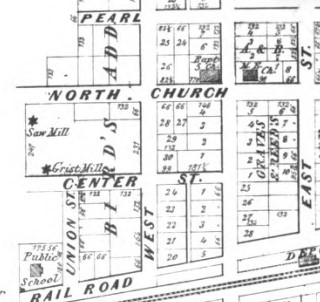
This unmarked photo above is one of two recently identified as showing some Clayton mills of the late 1800's.  The area bounded by North Church, West, Center and the adjacent field to the west was the site of saw mills, grist mills and for a short time a carding mill operation.  The man 2nd from left with white tie and umbrella appears to be George R. Mills, Engineer, as seen on the Michigan 1884 census in Clayton.  Mills grew up near Hughes Hwy. on what is now M-34 and his family ran a steam sawmill there.  He was my husband's great-grandfather.  The building in the far left, just above the men's heads, looks like the gambrel-roofed house still standing on the NW corner of Center and West streets.  It is barely visible except for the roofline.  Notice the boy with the bundle of staves and the others with hoop material for barrel making.  A small notice in The Adrian Daily Expositor of Dec. 5, 1881:  "Cross Bros. of Clayton have sold their mill in that village to Mr. Hicks of North Adams, Hillsdale county, who will add to it a large stave mill."

Clayton Steam Grist Mill, Hudson Museum photo, circa 1884, built by Cross Bros. in 1873 following a fire at the previous grist mill owned by Aaron Abbott and bought by William Hix around 1881 (sometimes spelled Hicks)  Mr. Hix appears to be the man with tie and suit jacket 4th from the right.  He is identified in the following newspaper clipping with 1880 Clayton Band photo from the Adrian Daily Telegram's old photo gallery of the 1960's.  

Clayton Band 1880, Mr. Hix 4th from right in middle row.  This identifies him as Fred Hicks, but he looks a lot like the man in the grist mill photo. (Update:  Fred was born 1866 & William's son according to FamilySearch.org--the man in the photos is too old to be Fred) Wm. Hicks owns the grist mill property as seen on the 1893 Lenawee Atlas shown below.  Other prominent Clayton men are in this band, including Warren Cooke with trombone right end middle row, father of the last banker Wilbur Cooke, who died in 1958. Clayton Exchange Bank was the last private bank in the state of Michigan.

.

1874 Lenawee Atlas Clayton
Saw and Grist Mills on Center Street
A fire in 1873 destroyed the grist mill of Aaron Abbott and it was replaced by Cross Brothers at a cost of $10,000, according to Aug 12. 1873 The Daily Press


1893 Lenawee Atlas Clayton
Wm. H. Hicks mill land with Avis and Hicks saw mill, and on the corner the Selleck and Avis Roller Mill on Center Street (here labeled "Hudson St.")


The 1893 map portion above shows the saw mill location labeled Selleck and Avis, at the block N. of Clayton school.  The picture directly above is from the 1874 Lenawee Atlas for Hudson Twp. Section 2 that is on Plank Rd. just E. of Henning Hwy., S. side of road.  I believe the house is no longer there.  But look at the home industry of Mr. Selleck, a steam saw mill.  He and/or his son James became involved with the Clayton Saw Mill of Selleck and Avis.  It is important to draw them into this story as the son married a woman named Rose who figures in the end of all Clayton Mills on Center Street.

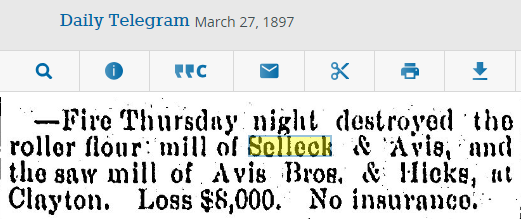
Below is an article explaining a bit about Rose Selleck, the burning of the mills, the trial and the verdict.  Note that the article says Prosecutor Bird and the court officers "felt very blue over the matter."  That is Clayton's own John E. Bird who later became Chief Justice of the State of Michigan 
Supreme Court.


January 10, 1898 Daily Telegram (published as Evening Telegram)


ROSE NOT GUILTY

------

The Jury Says So After Hours Deliberation.

------

THEY SPENT SATURDAY NIGHT IN THEIR ROOM

------

Stood Eight to Four up to Midnight, Saturday Night

------

Came in Once with a Disagreement—Sent Back

The jury in the Rose Selleck arson case has created a profound sensation by returning a verdict of “not guilty.”  This was contrary to general expectations, as bets were being offered and taken even up that they would either convict or disagree.

The case was given to the jury at 9:15 Saturday morning, and after eating their dinner in their room, they came out at 3:30 that afternoon, reporting that they were unable to reach an agreement.  Judge Chester told them that the nature of the case was such he thought they should come to some kind of an understanding.  This was the second time the case had been tried and both trials had been thorough tests, going over the testimony at great length.  He would therefore suggest that the jury retire again and further consider the case.

At midnight Saturday the jury announced again that they were ready to come out.  The court was assembled, and the same disagreement was reported by the foreman, Horace Holdredge.  They were sent back again by Judge Chester, to consider the case further.  Under Sheriff Shepherd and Deputy Sheriff Knowles were placed on watch and stayed through the long watches of the night.

Sunday morning Judge Chester had everything in readiness so that he could go home to Hillsdale on the 8:37 Lake Shore train, in case a verdict should be rendered.  He was at his private office in the court house early, and a carriage was in readiness to drive him to the depot, if a verdict should be rendered.  Notification was sent to the jury, through Under Sheriff Shepherd, to change from the small jury room in which they had spent the night, to the supervisors’ room, where there was more air.

Under Sheriff Shepherd rapped on the door and notified Foreman Holdredge what was about to take place.

“Wait a moment,” said Mr. Holdredge and the door was again closed.  The court and officers waited about 10 minutes, when there was another rap from the inside.  The foreman announced that they had reached a verdict.  They were brought into the court room, where Judge Chester, Rose Selleck, her friend, Miss Estella Warner, L. R. Salsbury and about 25 men, who had waited around the court house all night or had dropped in, were assembled.

The foreman of the jury announced that they had reached a verdict.  He was asked by the court what the verdict was.

“We find that the prisoner is not guilty of the crime charged against her,” was the response.

The jury was dismissed until Monday, the court adjourned, and Judge Chester just caught the train for Hillsdale.

The weary court officials and the member of the jury went home for a rest.  Mrs. Selleck and her friend took rooms at the Lawrence hotel, and took a long needed respite from the strain of the long trial.  She was naturally pleased about the verdict.

------

How the Jury Stood

This is a problem that is difficult of solving, and may never be known to a certainty.  It is given out by the jurymen that they were sworn to secrecy among themselves, but some of them have been telling different stories about their deliberations.

One juryman stated that they stood 8 for acquittal and 4 for conviction when they took the first ballot, and they stood that way all day and night, until five minutes before they came out on Sunday morning.  At that time, states the juryman, they saw the carriage drive up to the court house, supposedly for Judge Chester, who was anxious to get home and not wanting to stay another 24 hours, they reasoned that no jury would ever convict, so in order to save the expense of another trial they agreed to a verdict of acquittal. 

It is quite positive, so we are informed that Foreman Horace Holdredge was for acquittal, and would stick to the end.

There are other rumors that the jury stood nine for acquittal and three for conviction on the start, and at midnight one was won over to acquittal, making it eight for conviction and four for acquittal.  This afternoon we have been informed that the verdict was right the other way, and it came direct from one of the jurymen, although he would not divulge any names.

------

Opinions

There are various opinions regarding the justness of the verdict, and we think the prevailing sentiment among the people is that the jury did just the right thing, under the charge from Judge Chester.

Prosecuting Attorney Bird and the officers feel very blue over the matter.  In their opinion Rose Selleck is guilty of burning the mill and they feel that if a conviction could not be had in this case there is not much use in trying.

------ 

From The Adrian Daily Times and Expositor, January 7, 1898 is article  about the "Second Mrs. Selleck."  The younger Mr. Selleck had divorced Rose and remarried to Rose's niece!  This is a long article comprised of testimony from the witnesses of Clayton, about the mills, the fire, people's  whereabouts and conversations, so it will take some time to transcribe.  It is available on the Adrian District Library website under Databases (it is not with the NewsBank service).  Some of it is illegible and there is a lot of detail.  

Saturday, December 16, 2023

Some Early Buildings of Clayton


Clayton Union School built 1867 Hudson Museum photo


Those of us familiar with the Clayton Centennial newspaper may recall the story of a feud between Reuben Bird and his tenant Aaron Abbott during one of the elections of President Abraham Lincoln.  Mr. Bird was thrilled that his candidate won the election and so he draped his entire house in red, white and blue bunting to celebrate!  Mr. Abbott was less than thrilled and pulled down the bunting on his rented half of the house.  Abbott and his family were only staying until their new house was completed but he did not want to put up with any celebration at all!  

And so I was wondering whatever happened to Aaron Abbott and found a published biography on him in the 1880 book History and Biographical Record of Lenawee County, Volume 2, by William A. Whitney.  Aaron was son to Ezra Abbott, an old farmer who settled here from the east and owned land out in the vicinity of Tomer Rd. and Seneca Hwy.  Old Mr. Abbott was also a carpenter and joiner by trade and his son Aaron picked this up and also farmed until 1852 when he traveled to California in engage in mining--returning home after completion of the Panama railroad in 1856.  Back in Dover Aaron farmed with his father, and in 1868 moved into Clayton to engage in the milling business.  The biography says that Abbott was known as the builder of the first brick Clayton school, Baptist church and downtown buildings known at the time as Abbott's Block.  
  
Mrs. Naomi Dowling's 1967 Clayton School Centennial booklet describes the Union School:  "The people were very proud of the new school house built of bricks, which were taken from the brickyard at the south edge of town.  The high belfry was trimmed in white as were the window casings.  A white picket fence was built around the schoolyard with a gate in front, which was kept closed so that the smaller children couldn't stray away."  

The memory of that fence stuck with these people who featured a portion of it on their Hudson Centennial Parade float called "The Old Front Gate." Names jotted on back are Kenyon Wirick, Ray Lyons, Echo Younglove Williams and  Arlene Haas Brown.  

The Old Front Gate 1933 Hudson Centennial Float from Clayton. Hudson Museum photo

We must note that the 1890 date handwritten at the bottom of the Union School photo seems to be incorrect--in the background it appears to look like "67" and a check of the  Directory of Early Michigan Photographers, Edited by Clayton A. Lewis, Copyright 2013 David V. Tinder; William L. Clements Library, University of Michigan (Google for online edition) shows this:  Dewey, W. W. & Brother, Photographers of Hudson for the years 1874-1875.  Also note that the girls' dress style of aprons over their skirts is similar to that of the girls in this Medina photo, of 1874-75 by F. D. Foster at https://backtooldmedina.blogspot.com/p/page-11.html   So I can only conclude that the handwritten date 1890 over other erased numbers is probably in error, and that the Clayton photo also dates from 1874-75, not too long after construction of the schoolhouse.  

This school was on the same site where the later 1909 school was built, the one that many of us attended.  The old school was torn down, and while the replacement went up the kids went to school in other places around town, like upstairs in the Perkins 3-story building and other locations.

                                                  --------------------------------------------------

Another building attributed to builder Aaron Abbott is the brick Clayton Baptist Church that used to sit directly across State Street from the present Clayton United Methodist Church.  The Baptist Church was at Clayton at an early date as it is on the 1857 Lenawee County Michigan wall atlas as "Bpt Mtng H" shown same location. This only known photo was taken from the fire house tower, so we see a side view here.  The Baker barn and farm house can be seen in the distance to left of the steeple.  This is a cropped copy of a photo from Lenawee Historical Society Museum.

Clayton Baptist Church taken from the Fire House Tower, construction date unknown.  Lenawee Historical Society Museum photo.--UPDATE See post "Early Clayton 1868" where the brick Baptist Church is already up, so construction year is on or before then.


1893 Lenawee County Atlas map of Clayton showing Baptist Church across from the Methodist Church on North State Street

                                                  --------------------------------------------------  


The last of the buildings to mention that are attributed to builder Aaron Abbott are those in the old Abbott Block, the two northernmost sections of the brick block on the west side of State, directly south of Burger's store.  Construction date unknown but believed to be mid-1870's.  The bank building on the far left  (or south) of this three-building group was constructed by a Mr. Haskins.


Brick block including old Clayton Exchange Bank on the left and the other two brick buildings that made up the old Abbott Block built by Mr.. Bird's tenant,  Aaron Abbott.  At one time the post office was here, right on the corner, before the present post office was built. 
Photo from Hudson Museum.


R to L Abbott Block, Bank and the white Commercial Hotel circa 1900.  Clip from scan of a circa 1900 post card from Hudson Museum.